Archive for the 'anecdoted' Category

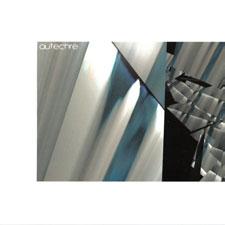
autechre, “confield”

Autechre, Confield (CD, 2001)

An unfortunate consequence of lack of faith is that it’s impossible to experience loss of faith. Valuing the loss of faith is, of course, libertine reasoning, emphasizing the value of belief in negative, but it is how I was thinking at a certain point in time. One doesn’t value faith as much when one has it; but one can’t really appreciate that until it’s gone and you’re outside of that perspective. It’s a tricky thing.

It’s hard to remember now how devoted I was to Autechre in 2001: as much of a completist about them as I was about any band, I had bought several of their CDs twice over, generally a expensive imports, as it seemed impossible that I could be living somewhere with a copy of Amber or Envane. Things like Napster existed in 2001, of course; but they were generally low-bitrate single track affairs, and over an Italian dialup connection it seemed like it took forever. And Autechre were as important to me as any band – the word is wrong, but “group” also has problems. I remember stumbling out of the Let’s Go office at dawn, or what seemed like dawn, to pick up the embargoed import version of LP5 the morning the guys at Tower Records said it would be available; I remember playing the second half of EP7 over and over again on headphones my first summer in Rome. Confield was the first full-length to be released after that.

Autechre hit that solipsistic sweet spot of being abstract but emotional at the same time; it was headphone music. There are all the affordances of dance music, but without the troublesome element of other people. This went all the way through: track titles were computerese, some sort of remixed English, and the graphics were abstract (or, with Amber, too perfect to seem real). The sound then was unrecognizable: it didn’t sound like anything. Now it sounds like plenty of other things; it sounds like synthesizers and drum machines, like dance music, if the dance music wasn’t particularly good at being dance-y and dignified that approach by saying it just wasn’t interested in dancing. Maybe it’s the sense of pure abstraction: there weren’t lyrics, and interviews with the two fellows behind the music didn’t really provide anything. The song titles are signifiers, though there’s not very much that can be read from them beside a love of technological obfuscation. Without sounds from recognizable instruments (for the most part) or much sense of how it might be made, the listener could hang anything he – it’s almost always a “he” – wanted on the music.

There have been a number of Autechre albums since then; I know I bought at least the next two, and maybe the third, though that looks less familiar. Another one just came out, and I dutifully listened to it, though I didn’t love it. The bloom came off the rose with Confield: I was disappointed with this record and never quite managed to get my enthusiasm back. Part of this was how important LP5 and EP7 had been: expectations build. There’s also the problem, of course, of what I wanted from the musicians: both to stay the same and yet to do something new, which isn’t really a nice place to put someone. Files calling themselves Confield had been floating around before the album was actually released; I dutifully downloaded them and liked them before finding out that they were fake: to the trash they went. After the actual album came out, I noticed that I’d liked the fake better than the real; that fake version seems to have vanished into the Internet, though I assume it’s still around somewhere.

Listening to it now, I wonder how many times I actually listened to this album. I expect that I listened to it over and over again on first getting, hoping that something would click and that I’d like it: that was something one did when there was an actual investment of capital in a record, when you had to justify why you’d spent L39,000 – is that number, the one I remember, really what I was paying for CDs then? – to find something worthwhile in that expenditure: music-buying was a strange thing. But I wonder if I ever pulled this CD out after 2001; it’s entirely possible that it’s sat in the CD-case in which I brought it from Rome since then. I can’t think of what would have impelled me to pull it out. Some of the sounds are nice (the first half of “Pen Expers,” for example, the metalic clanging in “Parhelic Triangle” that’s almost chiming), but the the rhythms remain arbitrary (the second half of “Pen Expers”) and don’t seem to justify their arbitrariness to my ears; there’s not a lot of melody, and one wonders whether the rhythms are entirely random. Nor is there much sense of drama, though there’s a hint of that in “Eidetic Cassein.” My taste in electronic music after 2001 tended towards the more regularly rhythmic: techno and house rather than this. I’d probably like more straightforward remixes of this, but I don’t know that anyone ever really bothered. A beatless version of this record might be very nice.

It’s interesting looking at dates now to realize how compressed the timeframe of my love of Autechre was: I would have bought my first record by them in 1996, and the romance would end in 2001, about five years. It seems much longer: maybe a lot was happening then. Up until this, there’d been something thrilling about the strangeness of each release: Autechre records didn’t sound like anything else. This one sounds like an Autechre record: but an Autechre record where they’re trying to be vexatious by not providing melodies. It’s a noisy record, like all Autechre records; but it’s not quite regimented noise, like the previous ones: rather, it seems to be noises for their own sake, rather than for any purpose. It’s hard to know what this record is for: it’s not something that can be casually listened to, as the unhinged rhythms keep jumping out, but it’s not quite danceable. Most of the tracks last six minutes when they would have been better left at two. Maybe it’s the problem of where the scene was then; even then, they had plenty of followers: I remember Funkstörung, but there must have been plenty of others. Aphex Twin had stopped being interesting by this point; the clicks & cuts aesthetic of Mille Plateaux and the rest of the Germans was clearly artier. With the Internet, it became very easy to find really strange things – this might be one of the dominant aesthetics of the past ten years – and the familiarly strange is left being just familiar.

Autechre played in the Brancaleone centro sociale some time near the end of the summer of 2001: I remember thinking that I really should go, as I’d never seen them live & they were supposed to be amazing. I didn’t end up going, being too disappointed in this album. Also, it’s worth noting, laptop shows at that point in time were by and large terrible. I am disappointed with myself for not going: probably Brancaleone itself would have been more interesting than the show. But the idea of waiting around with a bunch of other Autechre fans for something that we all enjoyed in solitude: that seemed like it might be going too far.

stereolab, “transient random-noise bursts with announcements”

Stereolab, Transient Random-Noise Bursts With Announcements (CD, 1993)

This CD, which arrived in the package that M. sent me a couple months back, is one of the oldest that I still have: I bought this in high school. It was, I’m fairly certain, used: CD prices then were exorbitantly high for high school students. I’m not sure when I would have bought it: summer 1994, maybe. I’m not sure where I would have bought it: probably a used CD store in Rockford? I remember bits of this (“Crest”) going through my head when I was working as a banquet server/busboy, which would have been my senior year of high school. This was probably the first Stereolab CD I bought – there’s the off chance that I bought Mars Audiac Quintet, from 1994, first, though I didn’t like that one as much as this one & sold it at some point. (Later I reconsidered this; I think I may have bought Mars Audiac Quintet three separate times, but I don’t remember what would have happened to make that be the case; in any case, I don’t think that I still have a copy.) Mars Audiac Quintet would have been in Spin or The Onion or whatever I was reading then to get ideas about music, but I liked Transient Random-Noise Bursts enough that I never sold it.

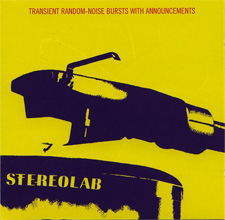
Stereolab’s been around for so long now – this CD is almost old enough to buy cigarettes! – that it’s hard to remember how strange they seemed at first: the constructivist red and yellow gear on the CD, the back cover text that seemed like it was from some weird hi-fi 1950s, the “æ” in Laetitia Sadier’s name, the tagline “Art is a science having more than seven variables,” ready for scribbling on desks. The front-cover graphic, a stylus on a record, abstracted almost to the point of being unrecognizable: certainly at that point I wasn’t attuned to design, but I knew that this didn’t look like anything else I was used to seeing. The booklet was also puzzling: photographs of electrical machinery that looked like it was from the 1950s with what look like JPEG-style graininess before the fact, and sample credits to people I’d never heard of but who would quickly become hipster touchstones.

The sound of this when you listen to it is still strange: from the start, there’s a lo-fi fuzz to it. Then repetition: later Neu! and Kraftwerk, but at that point the krautrock tradition was entirely unfamiliar. Music with synthesizers was frowned upon as being frivolous: there were guitars and bass here, which fit into what we understood as indie, but this was something different: there was pop here, in “Pack Yr Romantic Mind,” but “yr” was spelled in the Sonic Youth way (derived, maybe, from Wyndham Lewis’s Blast?) which made it safe; a growling guitar bridge suggested that they could tear off into something fierce if they wanted to. And the lyrics: some of them were on the back cover; some of them were in French. Most were, again, repetitious; “Pack Yr Romantic Mind”‘s read, in full

The greater is the beauty,
The profounder is the stain,
Humanity
Significant of the forbidden is transgressed in eroticism.

Now one thinks “oh, Bataille,” but then it was hard to know what to make of that: Sadier’s voice was lovely, the English was choppy, one wondered what their being Marxists meant. There were not any Marxists in rural Illinois. It did sound nice, though. Now I understand why “Pause” is described as “Proust song” (“Retrieve the past / like a prayer / Bringing it back / Into the light”); at the time, this reference, like most of the others (“Ondioline,” “One Note Samba,” Gershon Kingsley, “Farfisa”), was opaque, something that might be tracked down. Wikipedia makes listening to this CD very different.

There’s a brutal drive to many of the songs on this album (the ends of “Golden Ball” and “Analogue Rock,” the entirety of “Crest”), and I think that’s what I responded to first: there’s an easy appeal to it. And of course the centerpiece of the album, the 18-minute “Jenny Ondioline”: there’s the same drive, the feeling that something could go on and on, which was very strange to someone whose idea of a long song was “Free Bird,” frequently played entire on the local classic rock station. The lyrics of that weren’t printed on the back; partially buried under the wall of sound, you can make out something about not caring if the Fascists have won, socialism still needs to build. It’s political, but the political sense comes as much from the drive of the music as it does from the lyrics. It winds down about seven minutes in, then starts back up again, without vocals, with more guitar. Vocals return: “take heed and lift up the struggle,” but again it’s hard to make out exactly what’s being sung. My politics when I was in high school were nothing if not incoherent, but there was something viscerally appealing about this. So much of my drive during high school was essentially reactionary, concentrating on leaving, being anywhere but where I was: this fit in perfectly. I don’t tend to like long songs, but this could go on forever: it’s that perfect.

For my college interview, I was asked to list three significant books; I put down something by Salinger, One Hundred Years of Solitude, and Bernardo Atxaga’s Obabakoak, at the time, I thought, the only Basque novel, which I found at the public library. In my interview, I talked about that book at length – nobody, of course, wants to hear a 17-year-old describe Salinger. In retrospect, I suspect that book had a lot to do with my getting into college: I’d found something strange, and I’d made it my own. Stereolab – especially this record – fits into the same category: an entryway. After arriving at college, I dutifully tracked down the rest of Atxaga’s work, and bought his new material when it came out; but it never had the same resonance for me.

It’s hard for me to say if I ever loved Stereolab. They were too hard to pin down: you could get what Pavement was about without too much trouble, for example, but Stereolab was a little too exotic, seeming to operate in some other plane entirely. I still like Stereolab, though, and dutifully buy their new records when I come across them; when finally I didn’t buy Sound Dust, I felt decidedly guilty. That was, of course, a mistake.

hüsker dü, “candy apple grey”

Hüsker Dü, Candy Apple Grey (CD, 1986)

huskerducandyapplegreyR. had an extra ticket for Bob Mould last week, so I went and saw him play, at the venue that used to be the Irving Plaza and now has some confusing hyphenated name. I was glad I went, as the show was much better than I expected: Bob looks good, he can still play fast and loud, and his backing band seemed young and excited. His voice is shot, but that’s probably to be expected. But he played a fair amount of his old work, including “Hardly Getting Over It” off this CD, which I certainly hadn’t been expecting. The last time I’d seen him had been a decade ago, in some seated venue in Boston filled with a balding crowd of aging punks; the whole thing was dispiriting, not least when a member of the crowd exhorted us to dance in the aisles to minor effect. The punks have aged further; but this crowd looked better, doubtless because in the time since I saw him last Bob Mould has become a minor gay icon.

I have acquired, as it turns out, a fair number of Bob Mould CDs in his various incarnations, starting with the Sugar CDs which I picked up back in high school and going up to one of the not very good late-90s solo Bob records, sweeping back in time to include most of the Hüsker Dü records. I’m not sure why: there was almost always something good on each of these records, but I’m not sure that I ever really unconditionally loved any of them, save for Sugar’s Beaster, with which I was briefly and unhealthily obsessed. They filled a certain need though: the teen need for angry depressive music; there was enough variation in the quantities to keep things interesting. Listening to Bob again, it was striking how concrete a lyricist he is: he deals in concepts rather than specifics, more pronouns than not, only the most basic of metaphors. It’s easy for the listener to insert himself into his abstractions. More discerning taxonimists of punk called Hüsker Dü “emo”; that word came to mean something embarrassing, but one could draw a connection.

I bought this copy of Candy Apple Grey in Rome in the summer of 1999; I think it was at the used record store on via dei Mille. Google Street View suggests the name was Millerecords, and that it’s still in business, though that’s hard to believe. For part of that summer, I was living in a third-floor apartment a few doors down the street. I have a distinct memory of sitting at the kitchen table of that apartment, listening to this CD on a rented laptop while working on the LG Rome book, on headphones, I expect. I was listening to a lot of punk and post-punk that summer: Joy Division & The Fall. I was being unpleasant.

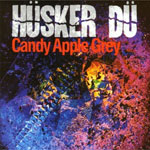
This is an intentionally depressing record: you can’t get around that. Listening to it, you get the sense that everyone in the band hated each other, which may well have been true, though I don’t know Hüsker Dü history well enough to know whether that’s true or not. This isn’t a record one can pin on any Roman narrative (though that summer some well-meaning graffitist was tagging Trastevere with the H¨sker Dü logo); this is unavoidably a record about young Midwesterners angry at how terrible the world is. It’s a hard record to listen to; I remember playing it over and over that summer, but I don’t know if I’ve played it since. It’s very easy to associate a record with a state of mind; there’s the temptation to blame it on the record, to claim susceptibility. I don’t know if that’s ever actually the case. But it’s an imposing record, from the front cover on in: the stenciled logo; the inscrutable art that suggests something industrial, an oil slick, maybe; the title, which refuses to make sense.

Most of all the sound of it, the sound of three people who aren’t having a nice time. The slow songs are the songs I remember here, songs I played again and again – Mould’s “Hardly Getting Over It,” which seems to be about a child’s apprehension of death, and Grant Hart’s “No Promise Have I Made,” a ballad in form, an angry break-up song in content. (The faster songs aren’t as memorable: the lyrics are equally despairing, but the production is too polished and it feels a bit too much like straight-ahead rock of the ’90s.) There’s a tension between Mould’s lyrics, exhaustive self-scrutiny that occasionally detours into the bathetic – “Grandma, she got sick, she is going to die / And Grandpa had a seizure, moved into a hotel cell and died away / My parents, they just wonder when they both are going to die / And what do I do when they die? “ – and Hart’s comical anger-for-anger’s sake. There are a couple airplane disasters for good measure. It’s a queasy record. I don’t know if it’s a good record.

But it is a powerful record: in my memory it’s an analogue for being unhappy with the world. Why was I unhappy with the world then? That summer I theatrically told people I was having an art crisis, that I wasn’t sure that there was any meaning in any sort of creation; where exactly that excuse came from, I don’t remember, but I did convince myself that was the reason for my unhappiness. Rome means anything you want it to. I was trying, with some success, to drag personal meaning out of William Gaddis’s The Recognitions; this was unfair to the book, I realize now, but it did seem vaguely possible that answers could be hiding somewhere in its apparent opaqueness. When all you have is a hammer, everything seems a nail; from inside this, it’s hard to understand this. A decade later, it’s nice to hear this record, but I don’t believe in it anymore: the sacred power’s drifted away, and it’s just a battered CD. It had its place: that’s something.

autechre, “basscad,ep”

Autechre, Basscad,ep (CD single, 1994)

autechrebasscadepWhen I left Cambridge for Rome, I generally neglected to make any plan for doing anything with those possessions of mine that I couldn’t fit into a suitcase. Some ended up in the Co-op basement; a majority were left in the Cognoscenti office in Winter Hill – as Cognoscenti went under while I was away, I don’t know what happened to those things – and a couple of boxes of books & CDs were left with people who might appreciate them. Some of these things came back, some didn’t; for the most part this was no particular loss. It’s a lot of work having things; or rather, it feels nice to leave them all behind: the idea of starting fresh and escaping one’s past seems increasingly impossible, but at the turn of the century there was still that promise.

So it was a surprise when an email arrived from M. a few weeks back saying that she’d discovered some of my boxes in her parents’ basement and did I want them? Of course I did; and a heavy box promptly arrived here full of books and CDs, a slightly used Christmas where I’d bought most of the presents myself. The books present a snapshot of a certain point in time: Richard Powers, Charles Olson, Melville’s Pierre, Evan Dara’s The Lost Scrapbook, a handful of copies of The Baffler: respectable, mostly. I did feel a twinge of disappointment that my signed copy of The Broom of the System is most likely lost forever. There were more CDs: a lot of Scott Walker, a lot of Autechre, some Stereolab, a bunch of inserts for CDRs handwritten in green pen, my Joy Division box set. Looking through these things, I can’t avoid feeling embarrassed for my past self’s pretentiousness – did I foist these things on M.? did she select them? I don’t know.; probably it’s not worth digging into.

This CD was on the top of the pile. It’s a CD single, the first thing I bought by Autechre; this would have been when I was a sophomore in college which was during the brief window when the record companies were putting out very long CD singles. They were cheap; every record store had a rack of them, and they often seemed like a decent risk when it was closing in on midnight at Tower Records, you needed something new, and had very little money. It goes without saying that most were terrible and the magic fell out of them quickly; so there was a lot of consideration of the rack. This one I know I thought about many times before buying: it was cheap and Autechre was associated with Aphex Twin, but it looked imposing. I remember almost being afraid of it: it might be too hard, I thought, though I’m not sure what that would have meant.

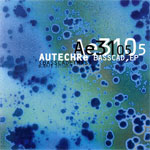
This CD still looks good: the cover image is blue and purple droplets on a green background, something like a restrained psychedelic light show, though more oceanic; the image on the reverse uses the same colors with video-like distortion. The text, though, conveys most of the affect: layered, screened out, multi-sized, negative leading. There’s a flagrant disregard for punctuation, connective words, spaces, and vowels; numbers are all over the place; the case of characters changes at random. It’s made to look technical: track numbers are given as “0.01″ and “0.02,” while track lengths are listed as “410SECS.” The inlay is clear. It’s dated now, of course: you look at this and immediately think Ray Gun or Designers Republic, early nineties – and this is, of course, a DR sleeve. It’s been done to death since. Fifteen years ago this looked hopelessly exciting: it smacked of “computers” when computers where still something things could smack of. The signifiers of science fiction are there, even if there’s no overt narrative: “basscadet” suggests “space cadet”; space ship displays would use the same monospaced fonts; in the future, everything would seem technical and we would have no time for spaces between words. A few years later computers would be out, but the sensibility filtered down to the masses; everyone was wearing t-shirts with big-eyed aliens on them.

The music is pleasant, if it no longer feels as dark and inhuman as it once did. It feels like techno: things happen regularly, there are occasional breaks, you could almost dance to it. Things build and repeat. There are vocals, but they’re deeply buried and the listener only gets the sense of words. The tracks are recognizably song-like if not songs; Björk could have sung over most of this. The track I remember liking most at the time was the “Beaumonthannanttwomx,” a remix done by one Beaumont Hannant: it feels sparkly, sounds echo back and forth very quickly, and there’s a majestic build. Now this feels like something I’d discount for trying to be emotionally manipulative: it feels too cinematic, though movies didn’t sound like this then. It’s sad and yearning: I can see why a teenager would have liked it. The Seefeel remix still feels claustrophobic in the right way, siren-like loops in a dubby echo chamber, the vocal samples distorted still further. It’s no longer techno, but a little too exciting to be ambient. The “Tazmx” slows down the techno to become something which feels more hip-hop than I would have admitted at the time, washes of strings, some scratches. Trip-hop, I guess. It outstays its welcome. The last mix takes away the beats of the original, stretches everything out, and adds echo, not quite dub but something close.

I decided I liked this & bought a lot of other Autechre CDs; the thrill wore off about the time that they came out with Confield and I realized that I liked the fake tracks that had been floating around the Internet more than the actual album, though I stayed with them for a bit. The whole project started to seem too hermetic: this is, at a very basic level, headphone music, a music about isolation. Now it seems like the music of a teen romantic.

acceleradeck, “narcoticbeats”

Acceleradeck, Narcoticbeats (LP, 1998)

acceleradecknarcoticbeatsIs it wrong for a project to have its clinamen before the rules have even fully been established? I’ve never actually owned a copy of this CD. At some point in the summer of 2000, I acquired a copy of this online in MP3 format; it was one of the two albums on my iBook when I moved to Rome in August of 2000. (The other was Neutral Milk Hotel’s In the Aeroplane over the Sea; I don’t think there were any loose songs.) The iBook, of course, had a tiny hard drive – 6 Gb, maybe? – but I did consciously want to ditch everything and start fresh. The only book I took that was not Rome-related was my copy of Ulysses, I think. Everything else went into storage: with friends; in the Co-op basement; or to be lost in a warehouse somewhere in north Somerville. I don’t think I’ve ever seen a physical copy of this CD – or the LP, which has another track – as I probably would have bought it, but my relationship with this record is at least in a sense proprietary. I’m sure this wasn’t the first record that I liked without owning; but this fits in at about the time ownership started to feel incidental.

Was this the last record I knew by heart? No. But it was on the way to that, you could see that coming. This was still a point in time when my relationship with media was defined, at least in part, by scarcity. I listened to this record over and over again because I couldn’t find much else like it. Part of that was defined by the sound: this record sounds like the lost My Bloody Valentine record should have sounded, a weird amalgam of shoegaze wall-of-noise with drum and bass beats. Later this would come to seem pedestrian; at that moment, it didn’t sound like anything else, or at least anything else that I knew. What “that moment” might mean is unclear in retrospect; looking at Discogs, this record came out in 1998, which seems right: was anybody trying to do drum and bass by 2000? Maybe it was a personal moment, though one wanted to feel there was something beyond that. One of the tracks from this ended up on the soundtrack to the Michael Almereyda Hamlet, the one with Ethan Hawke and Julia Stiles, with Kyle MacLachlan as Claudius, which I saw in the Pasquino in Trastevere; at a certain point “Greentone” played, and I had a moment of recognition. That soundtrack also had Four Tet (“Calamine”) & Primal Scream (“Slip Inside This House”), both of which I was listening to at about that time, and I felt, briefly, one step ahead of the culture industry. One could feel educated for recognizing the spines of Mayakovsky being used as set decorations. Obviously all of this was ridiculous. I would like to see that movie again, though.

Listening to this record now, I can see why I liked it: it wavers between sad and blissed out, and there’s enough tonal variation to keep things interesting. The drones don’t feel quite as dense as they felt then. Parts of it feel distinctly heavy-handed; what I like best are the parts at the end of the tracks where things feel unsure. The problem is the drumming: a beatless version of this might be very nice, but the later, more ambient tracks, do tend to drag. Some of it feels too cinematic, too overly dramatic. You can see why it would work as a personal soundtrack – I feel like at that point in time I was using a Minidisc player (a purchase made with vague ideas about field recordings) as a Walkman – but you wonder about the sort of person who would choose to use this as a personal soundtrack.

I did end up buying myself a copy of this on vinyl, which comes with a twenty-minute long fourth side, which is more of the same drones-n-drum-n-bass, although not as interesting as I remember hoping it would be when I was fruitlessly looking for this record in record stores. (The impulse to own was still strong: just having a copy of the MP3s wasn’t enough then. It was also true that my hard drive wouldn’t hold more than two hundred songs or so at the time. And it is true that the vinyl is a lovely key lime: it’s hard not to like something so cheerfully colored!) I’m not actually sure that Accelera Deck was, in the end, a particularly interesting artist; the guy put out huge numbers of releases, some of which I dutifully listened to and none of which, aside from this one, the first I heard, ever made any impact on me. (There was also the sense that he was tending a row that had already been thoroughly picked.) Later I think he ended up in the noise scene, which maybe makes sense. Maybe he’s found somebody to appreciate him.

icebreaker, “distant early warning”

Icebreaker, Distant Early Warning (CD, 1999)

icebreakerdistantSomewhere in the eastern periferia of Roma there was –is, it looks like – a club so called because of the single palm tree in front of it. (Google seems to show this palm tree, though it’s hard to be sure from above.) La Palma was at that point in time exciting – maybe it still is, I can’t say – and most of the touring American indie bands playing Rome at that point in time played there. Living in Italy was, predictably enough, the high-water mark of my interest in indie rock. It was 2000; things were confused. This would have been at about the same point in time that I tried learning Italian from a facing-page translation of Finnegans Wake. Bad ideas were everywhere.

I was at La Palma, by my memory, a number of times. Looking at where it is on the Google map, I’m confused by this: how did I get there? I think there was some sort of local train that was not the subway that went there; I have vague memories of a run-down train station in the middle of the night. And I remember getting home by walking – at that point in my life, I didn’t use taxis (this was not a thought-out behavior, it’s just how things were) and the trains didn’t run at three in the morning, so I walked home. Google maps suggests that it would have been just over five miles back to via Plauto, over by the Vatican – was I really walking five hours through the outskirts of Rome at four in the morning, presumably after I’d been drinking? I remember bits of this – passing by the Cimitero Monumentale del Verano, which is enormous and surrounded by little shrines with candles, even in the middle of the night. And Porta Maggiore late at night, with carts selling porchetta and prostitutes – I remember being very tired there, knowing that it was still an enormous distance to anywhere even if I was at the old city limits, and wishing that the subway ran all night. And coming across the Piazza della Repubblica as the sky began to lighten and feeling at home in the city. It seems odd to have been doing that much walking late at night – in terms of distance, it’s roughly akin walking to Central Park from Jackson Heights, which seems somehow inconceivable. Another detail: I wouldn’t have had headphones to keep me entertained while I walked along the highway. That was how I lived then. It’s odd, really.

La Palma was one of the centri sociali, I think, though it was more of hipster than the usual hippy. They’d play Lee Hazlewood & Nancy Sinatra before shows – what did it mean for Italians to be listening to that in 2000? I am out of my depth. Hood was playing there & as my postrock dues were paid up – it was during that brief window where one could listen to Godspeed You Black Emperor and not feel enormously depressed about the world – I went to go see them. I don’t remember very much about Hood – they always sounded very nice on paper, but I never really loved them, though maybe I was listening to the wrong records. Later they fell in with those terrible underground rappers who destroyed everything they touched and it was clear it was time to stop caring. But that was later, this is still 2000, they were on a promising postrock label from Chicago called Aesthetics, and at the time they seemed pleasant. I was, remember, in a susceptible state. It was nice to be in a place where they played Lee Hazlewood & Nancy Sinatra. Is it possible that L’Altra was playing with Hood? Maybe. There might have also been a terrible Italian opening band. I don’t remember anything about Hood.

This CD, though, I’m fairly certain that I bought this CD at that Hood show. I’d never heard Icebreaker (later Icebreaker International), but they were advertised as a side-project of Piano Magic, and they’d shown up in The Wire. (At that point, the magazines that I was reading regularly were The Wire, i-D, and the Times Literary Supplement, make of that what you will. Youth!) But I walked this CD home and opened it up, and the inside flap (all the well-designed CDs of that period were digipacks) explains that this is a record about NATO’s distant early warning system, which is almost a good concept for an album. (Their next album, which I bought when I arrived in New York, firmed up the conceptualism: entitled Trein Maersk, it was ostensibly recorded on a container ship of that name sailing around the world; straight-faced soundbites paid tribute to the glory of free trade, and the band had decided that it was okay to like techno, which improved things tremendously. That this was an enormous – and reasonably good, considering – joke was lost on most of the critics.) The tracks have names that fit in with the concept (“Co-prosperity Sphere,” “The Arctic Night,” “Reconnaissance Flight”) though all are instrumentals and one suspects that the titles were added after the fact.

Concept aside, the first track of this 49-minute CD (“Melody for NATO”) is far and away the best. This had appeared on a split 7” with Piano Magic; had I been more discerning and in a place where Piano Magic 7”s could have been procured, I could have skipped this CD entirely. Believing at that juncture in time that artists’ intentions should be honored and CDs should be listened all the way through, I listened to this CD all the way through many times; I remember nothing about any of the other tracks except that they’re mostly warm drones; looped synthesizers, a few Arctic-feeling samples, maybe, drums on a few tracks. They’re not at all unpleasant, but they’re nowhere as nice as the first one, which feels like a slow pop song without words. It’s a fine CD to put on when you’re going to bed – the first song is nice and then you’re asleep & things are happily going on in the world without you.

isan, “salle d’isan”

ISAN, Salle d’ISAN (EP, 2001)

isansalledisanSomebody’s family had a house in New Hampshire – was it really New Hampshire? one of those New England states where there’s a lot of winter – and I remember being in a large house and playing this late at night there. Why would I have done that? From this distance it seems like a horrific breach of good taste; I remember being upset at a party a few years later when a boorish friend of a friend brought his own music, terrible middlebrow indie, and started playing it, noting how he disapproved of the band’s politics (which really were the least offensive thing about them). Rochefoucauld says something about this, of course.

It’s not the worst thing to play late at night in someone’s cabin in the woods, I guess, but this is much more headphone music than anything else. This CD goes on for seventeen minutes; there are six tracks, but only the fourth, “Fullen Brimm,” sticks, because that has a much better bassline than any of the others (which seem to lack bass entirely). It’s almost menacing: things are layered on top, there’s some very delicate dubbiness, there’s a nice tension. The track before it, utterly forgettable, is named “Disruptive Elephant,” which I like; you always wonder if things have been mislabeled. I always wanted to like the other tracks more but couldn’t find anything to latch on to. With a CD, if you play one track over and over again you feel like you’re doing something wrong. Listened to now, the other tracks seem to verge on Tangerine Dream-style new age; there’s a little crunch that makes things uncomfortable, but this is overly pretty.

In Rome, I’d been listening to a lot of American indie; when I moved to New York, I was listening to much more wordless electronic music, the Björk album of that year being the fulcrum between the two. I wonder why? In New York, terrible indie music was all around – the Strokes and the White Stripes were in their ascendency – and it didn’t quite feel special. Electroclash was more entertaining, if obviously ridiculous, though that didn’t really seem like something one listened in a recorded form. Maybe my turn was a reaction against the static of the city. There’s not much public space in New York; when one arrives without money, there aren’t that many places one can go. Loitering is frowned upon. Thus, headphones.

piano magic, “son de mar”

Piano Magic, Son de Mar (Music from the Film by Bigas Luna) (soundtrack, 2001)

pianomagicsondemarThis CD has one of those stickers that says MADE IN ENGLAND on the back, which means that it would have been more expensive. I wonder if that’s still the case? I remember buying it at Other Music on West 4th; probably I’d left work from lunch. Is that possible? The office in fall of 2001 was at 8th & 15th; would I have walked so far? Maybe not. Is it possible that I bought this before getting a job? Maybe – I came back from Rome having listened to Low Birth Weight over and over again & wanted more Piano Magic, immediately. Seasonally Affective, a compilation of their EPs, was released just as I moved to New York; I remember listening to it while in the New York Public Library, trying to find myself a job and an apartment. This would have come out soon after. I do have a distinct memory of buying it at Other Music and hastily unwrapping it to put it in the Discman; that was what you did then, the fastest way of consummating desire.

This is a beautiful CD – it was the first record Piano Magic did for 4AD and they took pains to make it look like a 4AD record. The pamphlet is a thick square of cardboard, which is a neat trick, as it feels unlike any other CD; moody stills from the Bigas Luna film are on the front and back. (I did get around to seeing this film several years later & can recall almost nothing from it – it wasn’t bad, it simply wasn’t that memorable, save for this soundtrack. The CD is six untitled tracks; parts of it are from A Trick of the Sea, which I’d also listened to over and over again. Somehow this reuse didn’t offend me – that record sounds like a soundtrack already: plaintive strings, wordless vocals, what sound like clocks, bits of found sounds, keyboards. Sounds of waves, of course. The last track, almost longer than the others combined, is propelled by a motorik beat: there’s more obvious looping and use of electronics if you pay attention, but it still feels organic.

The Piano Magic aesthetic – miniaturism, the analogue, reimagined Victorianism – has became oddly dominant in the past decade. There’s an exhibition of the sets of the Brothers Quay up at Parsons right now, and it’s strange how familiar their creepy dolls, hand-cut paper, and bits of taxidermy have become. It’s the same impulse that led others to old-timey music at about the same time, probably: as the present becomes increasingly electronic, the past becomes more appealing. The Piano Magic records still sound distinctive – I can’t think of anything that sounds quite like this now – but maybe less so than they did; there’s been a stampede to reclaim the past, and I’m sure I’d find that somebody’s mining this territory if I bothered to look.

This isn’t quite as nice as A Trick of the Sea, which has spoken-word vocals which give it just enough purchase on the ear. This is evocative – everyone likes the sound of the sea, especially if you’re from the Midwest – but it loses hold very easily. The Piano Magic records past this one tend to get trapped in their own despair, only occasionally transcending it. I like this, listening to it now, but the sadness in it threatens to become overwhelming. Rolf accused me, at about the time I would have been listening to this, of only listening to sad music. That was my problem, he said, and also I was not lucky enough; luckiness, he proposed, was a skill that could be cultivated. It’s hard to argue with that.

It’s hard to remember what purpose background music served. I would have played this while alone, reading, probably. Painting? I was painting then, sometimes. Would I have played this at work? This is evening music, it wouldn’t have seemed right. I don’t think I would have, I had that much sense.

the american analog set, “updates”

The American Analog Set, Updates (EP, 2001)

amansetupdatesI remember a couple of American Analog Set records in college – they’d been pegged as the un-intellectual Stereolab from Texas – but for some reason I was taken with the album they released just before this EP, which was less droney and more warm indie. It’s possible they were the first band I saw in New York? maybe in September 2001? but that doesn’t seem quite right, I don’t think anything was happening that month. They headlined a show at the Bowery Ballroom where Interpol opened & you could tell by their fans that all was not going to be well in the coming decade. The date on this CD says 2001, but I feel like I probably bought it early in 2002; in the fall of 2001 I was too poor because I’d just moved to the city.

Certainly I associate this with a cold winter in Brooklyn; I don’t think that winter was much colder than most winters in New York, but the landlord hadn’t bothered to insulate the room that I was living in (which protruded into the back yard of the apartment), reasoning that it would be cheaper to give me a space heater. But that was the winter of twee/electronic crossover; there was the Notwist record & the first Ulrich Schnauss record (a CDR of the two of them back to back) and all the rest of the early Morr Music/City Centre Offices people – Isan, Lali Puna, Arovane, Static, Solvent. They sounded nice on a Discman as one trudged through snow to a job that was unbelievably terrible but seemingly inescapable: ineluctability was in the air. I was reading Thomas Bernhard and Hermann Broch.

(Discmen were everywhere in New York at that point; on the subway, it seemed like everyone had them. I remember being surprised; in Rome, it would have been very strange to wear headphones on the bus or the subway. Discmen had become extremely cheap; soon they’d be replaced by iPods, but at that point everyone carried around little books of CDs with them. I would have had a (restrained, tan) Invicta backpack at that point – I wonder what happened to it?)

This record, though: there are six tracks, two remixes each by the American Analog Set themselves (one presumes), Her Space Holiday, and Styrofoam. I would have bought this for the Styrofoam remixes, which I probably played over and over, just as I’d done with his A Short Album about Murder. Listened to now, the AmAnSet & HSH remixes sounds utterly unfamiliar. The first two sound unfinished. Her Space Holiday I never liked for some reason; maybe I was disdainful of them for not being German, not feeling like they came out of a tradition. But nothing grabs me about these tracks here; the originals are recognizable under layers of noise (the first) and faux hip-hop shifting to faux drum & bass (the second), but I don’t know that they’re especially nice as songs – I think I liked the sound of the originals rather than the songs themselves, maybe evidence of a change in how I was listening to music.

Listened to now, the Styrofoam remixes seem emo beyond all hope of redemption. On the first, looped melodramatic keyboards are layered with plastic crunchy drums & strategically placed noise while the original vocal floats serenely through; warm bass builds. At the time this was some sort of dream come true: German electronics meeting American indie pop. Dntel would do roughly the same thing a year later with a better vocalist and less Germans & turn into the Postal Service & then everything would be over, but this sounded fantastic over headphones walking through snow. Listened to over speakers now, it sounds a bit too much like they’re trying for the cinematic. The second is named “We’re Computerizing and We Just Don’t Need You Anymore (Styrofoam’s freezer burn mix)” which seems about right: glitched vocals, warm synthesizers. It’s a pop take on IDM, I guess, which seemed like a valid approach at the time: the Warp acts had run into a wall at about that point, and this seemed more palatable than Mille Plateaux-style clicks and cuts. Probably the clicks and cuts would sound friendlier now; probably some of that holds up better than this.

Things were generally less bleak after the winter of 2001/2. I lost touch with what the American Analog Set did some time after this, though I feel like I saw them do a show at the Knitting Factory a year or so later; by that time everybody else was doing the exact same thing & they weren’t so distinguished. Styrofoam went more indie (like the rest of the Morr Music stable) and it was roundly terrible and I stopped listening to him. Oh well.

gert wilden & orchestra, “schulmädchen report”

Gert Wilden & Orchestra, Schulmädchen Report (compilation, 1996)

schulmädchen reportI would have first heard this in the summer of 1997, I think, when I was, for reasons still unclear to me, the associate editor of Let’s Go Ireland 1998; probably my hearing this was the fault of Alex Speier – who might have become the Harry Crosby of the late-90s Let’s Go set after writing the masterpiece that is the Harvard Student Agencies Bartending Course (available at Google Books in mutilated fashion), though thankfully he seems to have turned into a successful sportswriter since then. As the cover suggests, this is a compilation of music from 1970s German porn films about schulmädchen; from the dubiously titled Crippled Dick Hot Wax, it fit in nicely with the wave of late-90s indie cosmopolitan exoticism (Pizzicato Five, Serge Gainsbourg, Ennio Morricone). The liner notes on this are minimal; one has no idea on how Mr. Wilden’s music fit into the history of German film music, if at all.

Though it seemed perfectly normal at the time, the Let’s Go office was an odd place to work, not least in that at that point in time everyone had their own computer with CD-player and speakers; as it was staffed by college students, everyone was constantly playing their music loudly, generally in counterpoint to everyone else’s. Schulmädchen Report soundtracked the Britain & Ireland pod for a good part of that summer, along with a Willie Nelson box set, the self-titled Blur album, a cassette tape of Irish drinking songs, and the new Oasis album, which Eric attempted to convince everyone was almost as good as their last one. There was very little variation in this diet  – no one’s taste matched at all, and those were the compromises that were worked out. Schulmädchen Report generally worked the best – the songs, cheerful to the last, vary in tone (the patriotic one, the rocking one, the Christmas one), and the disengaged worker could spend a long time speculating on what acrobatics might have been going on in the films these songs soundtracked. Nobody ever though to track the films down, but someone knew someone who had seen one once. Probably we played this once a day for most of the summer.

When Sam and Eric and I worked at Cognoscenti, did we listen to this? I don’t remember that, though it’s certainly possible. But the mood would have changed by then, I think; it wouldn’t have been summer, and this is a summer record. Records wear out, probably this had worn out.

The disc I have isn’t the original, which I seem to remember bequeathing to someone – a roommate? the Co-op? – I bought a second copy, presumably identical to the first, a few years later. It’s nice to hear. This would be a nice record to have in a car, maybe. No, actually: it’s too obviously a soundtrack & you’d feel foolish.